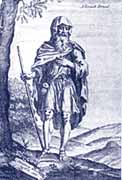
  Druid in ceremonial robes. Today, ever growing groups of people are becoming fascinated with Celtic lore even to the extent of practicing their religion. Just recently, the UK recognized druid paganism as an organized religion for first time in modern history. Those who choose to practice this religion in the UK can now receive tax exemptions on donations and have the same government status as any other "mainstream religion". When druidic pagans worship, they meet in groves of trees like oak, in caves, in remote valleys or in stone circles. The circles represent their wheel of life where they would through the practice of chanting, divination and channeling, call upon particular pagan gods or goddesses for what they believed to be communications between the living and the dead. Ancient stone circles are abundant in the UK and Ireland such as Stonehenge in England. 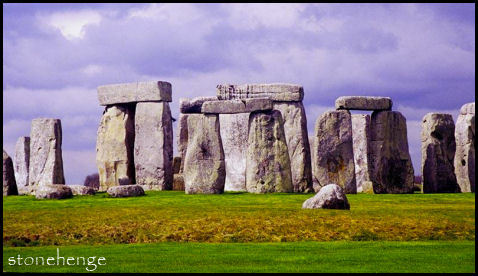
Very little archaeological evidence of the druids has been found, but there is agreement between Roman and Irish documents. Both clearly state that the knowledge of the druids was never committed to writing but passed from generation to generation by oral teaching. This was to protect their secrets. The same is true today. Nothing is put into writing and the modern day druids continue on secretly with many of the same traditions. Among the solstices, there were four high days celebrated throughout the Celtic territories: Samhain, Oimbolic, Beltane & Lughnasadh. 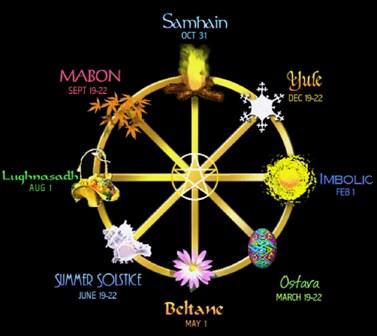 These pagan holy days are traditionally referred to as fire festivals because to the ancient Celts, as with all pagan religions, fire was a physical symbol of divinity, holiness, truth, and beauty. Sacred to them, fires were kindled on every important religious occasion and were also associated with the pagan holidays to symbolize and worship the power of the sun. On the eve of the pagan feast of Samhain or "Samhuinn" pronounced "sow-en", (The word sow pronounced like cow) the Celts kept bonfires burning while believing that this would protect them from evil spirits. They would take embers from the festival bonfire and light their household fire. Should the household fire go out at some point during the winter season, it was considered an omen of death or misfortune. The word "bonfire" is a shortened form of "bone-fire". It is said that they were originally large community fires used to burn animal bones. Celtic lore tells us that they believed the souls of the dead were confined to the bodies of lower animals, and at the time of Samhain, they were released by the pagan "lord of the dead" through the bone-fires and sent to their new afterlife. Celtic people would burn crops and animals as sacrifices to their deities. The Celtic pagans believed that by giving the gods and goddesses their share of the previous years livestock or crops the sacred fires would cleanse them of the old year and help them prepare for the coming new year. Very early Greek historical accounts told of Samhain being immersed in blood and human sacrifice. These sacrifices were said to be captured battle prisoners burned alive during the festival. Years later, after Rome ruled the Celtic lands, the bonfire was broadened to include fires used to incinerate corpses, heretical books and heretics. To this very day, among Eastern and Western religions, you can't have a satisfying pagan religious ritual without a bonfire or a few candles being lit. 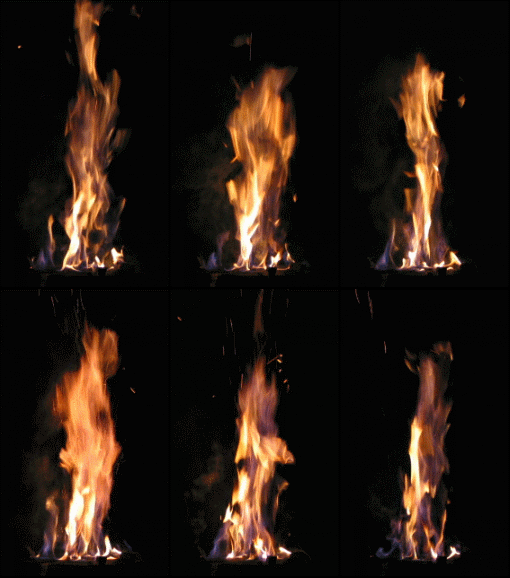 Samhain to the Celtic pagans was and is the most important of the fire festivals, because it marks the pagan New Year. During the celebration, the Celts wore costumes, and danced around the bonfire. The Celts believed that souls were set free from the land of the dead during the eve of Samhain that had been trapped in the bodies of animals. Wearing of costumes helped signify the release of these souls into the physical world. Many of these dances told stories about pagan cycles of life and death commemorating their wheel of life. Costumes were worn to hide from the evil spirits that would show up and escape their trickery, honor the dead who they believed were allowed to rise from the pagan otherworld, and ask their many deities for favor during the coming harsh winter months. Samhain was the original festival that became the evening before All Saint's Day after Rome conquered these lands and renamed many of their festivals giving them Christian names. Since the Celts like most cultures, started every day at sunset of the night before, this feast became Hallomas in honor of those believed to be saintly or halowed. This night later became Evening of All Hallows or Hallowed Evening which was eventually contracted into Hallow-e'en or the modern Halloween. 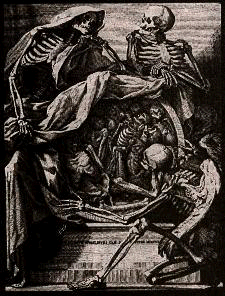 Pagans believed the dead walked the Earth during Samhain. Samhain was considered among pagans, a very magical time where the spirits of the dead walk among the living and the veils between past, present and future were lifted. They believed this time had to do with a temporary victory of the forces of darkness over those of light, signaling the beginning of the cold and dark half of the year. They also believed some of these spirits of the dead were trick-bent or harmful and were believed to assume grotesque appearances. Traditions then developed that if one could costume himself to look like a spirit, the spirits would not be able to plague him. Some traditions said the spirits could be warded off by carving a grotesque face into a gourd or root vegetable such as a turnip or large potato and setting a lit candle inside. The term "Jack of the Lantern" first appeared in print in 1750 as a night watchman carrying a lantern. Previous to this printing, it was used to describe a strange light flickering over the marshes of Ireland known as "ignis fatuus", meaning "foolish fire" in the Gaelic language. Irish folklore also tells a story of a stingy drunkard named Jack who had the misfortune of running into the devil in a pub on Halloween. This story, like many in folklore, has a lot of different versions, but they all end with Jack doomed to wander in the darkness alone through eternity with his lantern. His name and turnip lantern to the Irish storytellers are synonymous with a damned soul. Pumpkins, an American native, were not used as "jack o' lanterns" until the late 1800's when Halloween was brought to America by Irish and English working class immigrants.  "Jack of the Lantern." Samhain was a time of chaos. Celtic society, like all early societies, was highly structured and organized and everyone knew their place. But to allow that order to continue, the Celts felt that there had to be a time when order and structure were abolished, when chaos could reign. Samhain was such a time. During this festival people did crazy things. Men and women dressed in costume, farmers gates were unhinged and left in ditches, their crops would be damaged, and people's horses and livestock were moved to different fields. Children would knock on their neighbor's doors for food and treats to appease the spirits much like the way we still find today, in the modern custom of trick-or-treating on Halloween night.  Halloween was not celebrated at all in America until the immigration of the working classes from Ireland and the British Isles in the late nineteenth century. The aspects of the holiday were very attractive to many young American people, and they borrowed or adapted many customs without reference to their pagan origins. Today Halloween is almost exclusively an American holiday. Most people who celebrate Halloween have no conception of its religious origins or its heritage of paganism and perceive it as just a fun time to dress up in costume and party. Who were the Celts really worshiping during Samhain? Put simply, the pagan "gods" are the fallen enemy. "And it came to be, when men began to increase on the face of the earth, and daughters were born to them, that the sons of Elohim saw the daughters of men, that they were good. And they took wives for themselves of all whom they chose." Bereshith (Genesis) 6:1-2 The sons of Elohim were set-apart beings created by YHWH to watch over and teach mankind. Eventually, a group of them lusted after the daughters of men (mortal women) and defiled themselves by having sexual intercourse with them...becoming fallen evil beings. Their halfbreed offspring were giants and mighty ones called Nephilim. The fallen taught mankind forbidden knowledge like magic, witchcraft, astrology, how to produce incantations to cast spells, knowledge of sexual perversion, knowledge of hallucinogenic plants and drugs, knowledge of metallurgy and the making of swords, knives and all sorts of weaponry for war. These fallen beings, their half breed offspring, along with forbidden knowledge given to man causing man's wickedness, were the reasons YHWH caused the great flood that wiped out every living thing on earth...saving only Noah and those with him in the ark. YHWH then bound and imprisoned many (but not all) the fallen beings who sinned against Him and defiled mankind by teaching lawlessness. The ones who are still lurking about in spirit form have tricked mankind throughout history into believing all sorts of delusions, and they even went on to create more half breed offspring. "The Nephilim were on the earth in those days, and also afterward..." Bereshith (Genesis) 6:4 So hopefully you now see clearly who is behind not only Samhain and the pagan religions, but ALL religion and doctrine of man. The world was then and is still wicked and evil because of the fallen enemy, as are the traditions of mankind. "And have no fellowship with the fruit-less works of darkness, but rather reprove them." Ephesians 5:11 Come out of Babylon and be free! Choose not to not partake in any pagan festival. The fact is, have no participation in any form of religion or religious worship. Just like Halloween, people practice "mainstream" religions without regard to the origins of the traditions they practice. I once considered myself "saved" because I simply believed in "God and Jesus" and went to church. What I didn't know was the origin of these religious names and traditions I used and practiced daily. Did you know that our Creator has a name? Our Creator's proper name is YaHuWaH. pronounced "Yahoo-ah". (written " יהוה " in modern Hebrew) This precious life saving name has been covered up almost 7000 times in today's modern Bibles, replaced with god or lord. Did you know that there is no salvation to those who don't call out to His name? Calling upon names like "Lord", "God" or "Jesus" will NOT save you! No religious practice or tradition will save you! Did you know that our Messiah came in His Father's name? Our Messiah's true name is Yahushua, pronounced "Yahoo-shoo-ah". (written " יהושע " in modern Hebrew) As you can see, He has His Father's name "Yahuwah" within His name, and in Hebrew, our Messiah's name means "Yahuwah is Salvation". So indeed, He truly came in His Father's name, to complete His Father's Torah. When our Messiah came to Earth, the religious order had banned people from saying the Father's name. In that time, speaking the name of YaHuWaH was strictly forbidden. Why do you think this religious order hated Messiah and put Him to death? Not only did Messiah speak the name of YaHuWaH, He told everyone that He came in His Father's name, and He had His Father's name within His own name. "See that no one renders evil for evil to anyone, but always pursue what is good both for yourselves and for all. Rejoice always, pray without ceasing, in all circumstances give thanks, for this is the desire of Elohim in Messiah Yahushua for you. Do not quench the Spirit. Do not despise prophecies, prove them all. Hold fast what is good. Keep back from every form of wickedness. And the Elohim of peace Himself set you completely apart, and your entire spirit, and being, and body be preserved blameless at the coming of our Master Yahushua Messiah!" Tas Loniqim Bet (1 Thesalonians) 5:15-23 "And we write this to you in order that your joy might be complete. And this is the message which we have heard from Him and announce to you, that Elohim (Yahuwah) is light and in Him is no darkness at all. If we say that we have fellowship with Him, and walk in darkness, we lie and are not doing the truth. But if we walk in the light as He is in the light, we have fellowship with one another, and the blood of Yahushua Messiah His Son, cleanses us from all sin." 1 YOHANAN (1 John)1:5-7 Come out of the wicked traditions and religions supported by the fallen enemy, turn away from sin and seek Yahuwah through our Messiah Yahushua! |
Want to know more about Yahuwah?
Here are some Scriptures about the importance of our Creator's name:
"Who has gone up to the heavens and come down? Who has gathered the wind in His fists? Who has bound the waters in a garment? Who established all the ends of the earth? What is His Name, And what is His Son’s Name, If you know it?"
Mishle(Proverbs) 30:4
“And I shall give signs in the heavens and upon the earth: blood and fire and columns of smoke, the sun is turned into darkness, and the moon into blood, before the coming of the great and awesome day of יהוה. “And it shall be that everyone who calls on the Name of יהוה shall be delivered. For on Mount Tsiyon and in Yerushalayim there shall be an escape as יהוה has said, and among the survivors whom יהוה calls."
Yoel(Joel) 2:30-32
“And it shall be, in that day,” declares, יהוה “that you call Me ‘My Husband,’and no longer call Me ‘My Ba'al.’ “And I shall remove the names of the Ba'als from her mouth, and they shall no more be remembered by their name. “And in that day I shall make a covenant for them with the beasts of the field, and with the birds of the heavens, and with the creeping creatures of the ground, when bow, and sword, and battle I break from the earth. And I shall make them lie down in safety. “And I shall take you as a bride unto Me forever, and take you as a bride unto Me in righteousness, and in right-ruling, and kindness and compassion. “And I shall take you as a bride unto Me in trustworthiness, and you shall know יהוה."
Hoshea(Hosea) 2:16-20
Side note: Ba'al = Lord (Baal is the Hebrew word for Lord)
"And it shall be, if they learn well the ways of My people, to swear by My Name,‘As יהוה lives,’ as they taught My people to swear by Ba'al, then they shall be established in the midst of My people. “But if they do not obey, I shall pluck up, pluck up and destroy that nation,” declares יהוה."
Yrimeyahu (Jeremiah) 12:16-17
“Your words have been harsh against Me,” said יהוה, “but you have said, ‘What have we spoken against You?’ “You have said, ‘It is worthless to serve Elohim. And what did we gain when we guarded His Charge, and when we walked as mourners before יהוה of hosts? ‘And now we are calling the proud blessed – not only are the doers of wrong-ness built up, but they also try Elohim and escape.’ ”Then shall those who fear יהוה speak to one another, and listen and hear, and a book of remembrance be written before Him, of those who fear יהוה, and those who think upon His Name. “And they shall be Mine,” said יהוה of hosts, “on the day that I prepare a treasured possession. And I shall spare them as a man spares his own son who serves him. “Then you shall again see the difference between the righteous and the wrong, between one who serves Elohim and one who does not serve Him."
Malaki (Malachi) 3:13-18
"Ascribe to יהוה, O clans of the peoples, Ascribe to יהוה esteem and strength. Ascribe to יהוה the esteem of His Name; Bring an offering, and come before Him; Bow yourself to יהוה In the splendor of set-apartness! Tremble before Him, all the earth. The world also is firmly established, immovable. Let the heavens rejoice, and let the earth be glad; And let them say among the nations, “יהוה shall reign.” Let the sea roar, and all that fills it; Let the field rejoice, and all that is in it. Let the trees of the forest then sing before יהוה, For He shall come to judge the earth."
1 DIBRE haYAMIM (1 Chronicles) 16:28-33
Here are some informative links and videos!
Yahuwah-is.net
Please watch all 7 videos. Here's a link to the first one.
Ha'shem (The Name) Revealed
Here's part one of 4 more videos...please watch all four!
Bereshith (In the Beginning)
Here are three videos on "The Great Conspiracy" Please watch all three in order as I have them listed below:
Great Conspiracy (part one)
Great Conspiracy (part two)
Great Conspiracy (part three)
Here is a link to the online version of "The Scriptures". When you get there, just use the drop down box at the top of the page to go to the different books and compare this version to the one you use.
The Scriptures (Institute for Scriptural Research)
Quite a bit of information about YHWH and ancient Hebrew on this site:
HalalYAHUAH My Heavenly Father's Name
I encourage you to pray about this information, and ask Yahuwah to open your eyes to His truth. The enemy has twisted this world and everything you think you know about life and spiritual matters. Don't be content to "follow along" with the ways of this world as the enemy wants. Don't blindly partake in traditions. Don't waste your time sitting in a church as they fill your head with lies and empty your pocketbook. Should you have extra money, give it directly to someone in need. Should you have extra time, help someone in need.
Seek truth, seek life, seek Yahuwah through Messiah Yahushua!
Shalom!